These free tools are built from the same frameworks Stephanie uses with Fortune 500 leaders. Grab them, put them to work, and keep building the skills that get you seen as a leader.
Allyship in Action:
A Free Mini-Course for Leaders
You Can't Be an Ally If You're Always the Hero
Most high-performing leaders built their careers by being the steady one: the closer, the problem-solver, the one who always gets it done. But here's the trap: what feels like helping is often just holding onto control. And control doesn't build trust. It builds dependency. In this lesson, Stephanie challenges the "spotlight leadership" pattern, the habit of centering yourself even when you think you're lifting others up, and shows why real allyship means stepping back so someone else can step forward.
How to Be Trusted by People Who Don't Know You Yet
Your title won't earn trust. Neither will your charisma. When you're leading across lines of difference, trust comes from one thing: pattern. Neuroscience backs it up. The brain scans for consistency, and when it finds it, vigilance drops and openness begins. In this lesson, Stephanie walks through all four stages of the ALLY framework (Ask, Listen, Learn, You Take Action) and shows exactly what trust-building looks like in practice when your team doesn't know you yet.
Inclusion Isn't a Committee. It's a Daily Choice.
Inclusion doesn't live in your DEI statement or your strategy deck. It lives in the hallway, the Zoom chat, the moment you either speak over someone or make space for them. Neuroscience shows the brain processes exclusion the same way it processes physical pain, which means micro-moments of belonging (or not) have real consequences for trust. In this lesson, Stephanie gives leaders a day-in-the-life picture of what inclusion looks like in practice: not as a committee outcome, but as a daily leadership discipline.
Stop Calling It Allyship If You're Not Listening
Most leaders think they're great listeners. Ask their teams and it's a different story. Real listening isn't nodding. It's not waiting your turn to talk. It's the kind of active, uncomfortable listening that stretches your ego, changes your mind, and builds trust across lines of difference. Neuroscience confirms that true listening activates the brain's empathy network, and cutting people off shuts it down. In this lesson, Stephanie breaks down four concrete signs you're actually listening and gives leaders a challenge that will immediately shift how their teams experience them.
Leading Up, Down, and Across With Allyship
Most leadership training stops at "how to manage your team." But if you're only leading downward, you're leaving trust, influence, and opportunity on the table. Allyship is 360 degrees. It applies to your direct reports, your peers, and the person you report to. In this lesson, Stephanie breaks down what ally leadership looks like in all three directions, with specific questions and strategies for each, and makes the case that how you lead when no one's watching is what tells the truth about your leadership.
Lesson 2: Harnessing the Power of Diverse Teams
Diversity Isn't a Checkbox. It's a Competitive Edge.
According to Harvard Business Review, teams with high cultural diversity are 35% more likely to outperform their peers in revenue, and they don't just come up with more ideas: they get to better solutions faster. So why don't more leaders harness that advantage? Because comfort is the enemy of effectiveness. In this lesson, Stephanie reframes diversity not as obligation but as optimization and gives leaders a practical audit to identify whose voice is missing from their team and why that matters for scale.
Culture Clash or Culture Catalyst?
Every team already has a culture: a rhythm, a code for who gets heard, and a set of unwritten rules. When a new leader steps in without understanding that code, the result isn't just awkward. It's costly. Research from Deloitte shows that leaders with high cultural intelligence are 3.5 times more likely to build high-performing teams. In this lesson, Stephanie unpacks why culture clash is actually feedback, not failure, and shows leaders how to bridge difference instead of bulldoze it.
Don't Just Collect Feedback. Lead From It.
More than 50% of employees say their employers do little or nothing with feedback. Nearly two-thirds say their engagement surveys don't lead to meaningful change. When feedback leads to silence, trust erodes and eventually people stop speaking up entirely. In this lesson, Stephanie applies the full ALLY model to the feedback loop and challenges leaders to close the gap between what they ask and what they actually do with the answer.
How to Lead When Leadership Doesn't Want to Hear It.
Sometimes your team tells you the truth and the people above you don't want to hear it. You've done the listening. Now you're holding feedback that's real, clear, and inconvenient. Leadership isn't tested when everyone agrees. It's tested when you're the only one in the room who knows what's really going on. In this lesson, Stephanie gives leaders a concrete framework for carrying hard truths upward, framing feedback as business risk rather than culture complaint, and modeling ally leadership even when consensus isn't there.
From Unheard to Understood: Listening Across Cultures.
A team that looks high-performing from the outside (deadlines met, cameras on, minimal drama) can be completely silent on the inside. Silence doesn't mean alignment. It usually means the absence of trust. When you're leading across cultures, generations, or communication styles, that silence has layers. In this lesson, Stephanie introduces the Listening Ladder (from passive to transformational) and gives leaders three diagnostic questions to audit how psychologically safe their team's conversations actually are.
Ready to go deeper?

Discover Your Leadership Type
If you lead people, ask yourself this: where is your leadership actually landing? Take the free assessment to find out where you are in your Ally Leadership journey and what to strengthen next.
Discover Your Leadership Type →

Make Your Voice Heard
Talented professionals do excellent work but struggle to make their ideas heard. The difference between being seen as capable and being seen as a leader often comes down to how you communicate in key moments. The V.O.I.C.E. Cheat Sheet gives leaders five practical conversation tools they can use immediately: Valued Voice (add insight that moves conversations forward), Obliterate Overcommitment (protect your time without apology), Interrupt the Interrupters (reclaim your space without confrontation), Communicate for Impact (connect your work to business outcomes), and Express Your Excellence (share your accomplishments with confidence). Each section includes ready-to-use phrases for real workplace situations.
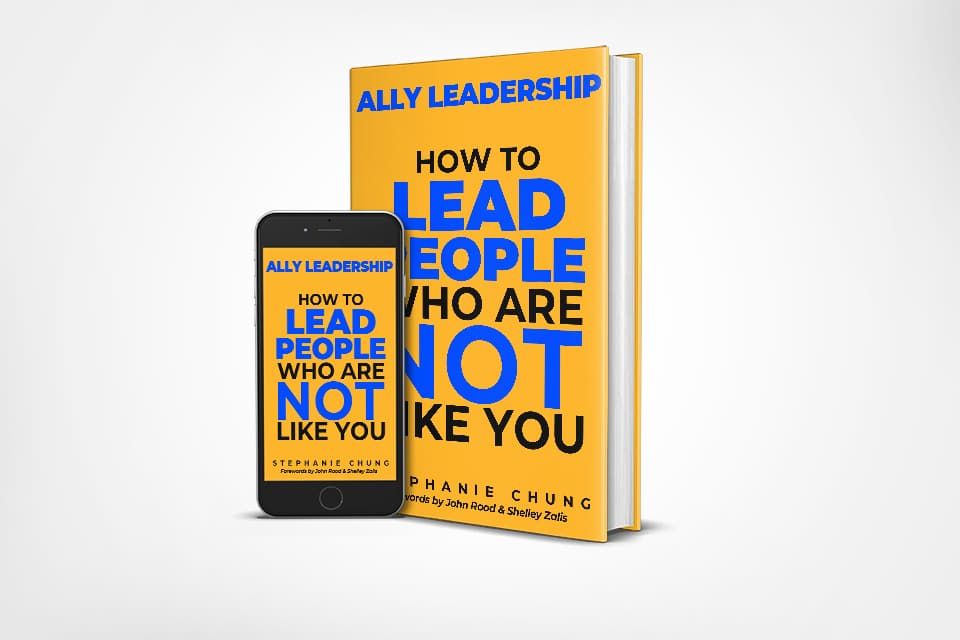
Grab the V.O.I.C.E. Cheat Sheet →Ally Leadership: How to Lead People Who Are Not Like YouI
Stephanie's book gives you the complete framework for building trust, earning credibility, and driving results with people who don't share your background or experience.
Order Your Copy →